

When a tooth is partially pushed out of its socket, the instinct can be to push it back into place or wait and see if the discomfort settles down. Both of those impulses can make the situation worse. A partially dislodged tooth, known clinically as an extrusive luxation, is a dental emergency that responds best when treated quickly and correctly from the very first moment.
At North Creek Dental Care, our team treats traumatic dental injuries for patients throughout the Southland community and understands how disorienting a sudden mouth injury can feel. Our general dentistry services include emergency care for situations like this, and we are here to help you protect the tooth and navigate the right steps without delay.
What Is an Extruded Tooth?
An extrusive luxation occurs when a tooth is partially displaced from its socket, typically pushed outward or elongated, while still attached to some surrounding tissue. The periodontal ligament fibers and blood vessels connecting the tooth to the bone are stretched or partially torn, but the tooth has not come out completely.
This type of injury most often results from a direct blow to the mouth, a fall, a sports collision, or any sudden impact to the face. The affected tooth may appear longer than the surrounding teeth, feel loose to the touch, or be visibly tilted. There may be bleeding around the gum line and significant sensitivity or pain when the tooth is touched or when biting down.
Complete Family and Implant Dental Care
Comprehensive dental services from routine care to advanced implants, all under one roof for your convenience.


What to Do Before You Get to Our Office
How you handle the tooth in the minutes following the injury directly impacts the outcome. According to research published by the National Institutes of Health, repositioning an extruded tooth requires careful technique, and the pushing force must be directed precisely to avoid further injury to surrounding structures. There are a few immediate steps to take and one critical thing to avoid.
Here is what to do in the moments after the injury:
- Do not push the tooth back yourself: applying force without proper assessment can damage ligament fibers that are still intact, compress tissue into the socket, or worsen a fracture that may not be visible
- Keep the tooth moist: do not let the root surface dry out. If the tooth has shifted outside its normal position, hold it gently between the cheek and gum while you make your way to our office
- Avoid biting down or eating on that side: any pressure on the injured tooth before treatment can deepen the displacement and complicate repositioning
- Contact us immediately: call our office or use our contact form so we can prepare to see you as quickly as possible
Taking these steps before arriving gives our team the best possible starting point when treatment begins. For patients who feel anxious about emergency dental visits, our relaxation dentistry options are available to help you stay comfortable throughout your appointment.
What Happens at Your Appointment
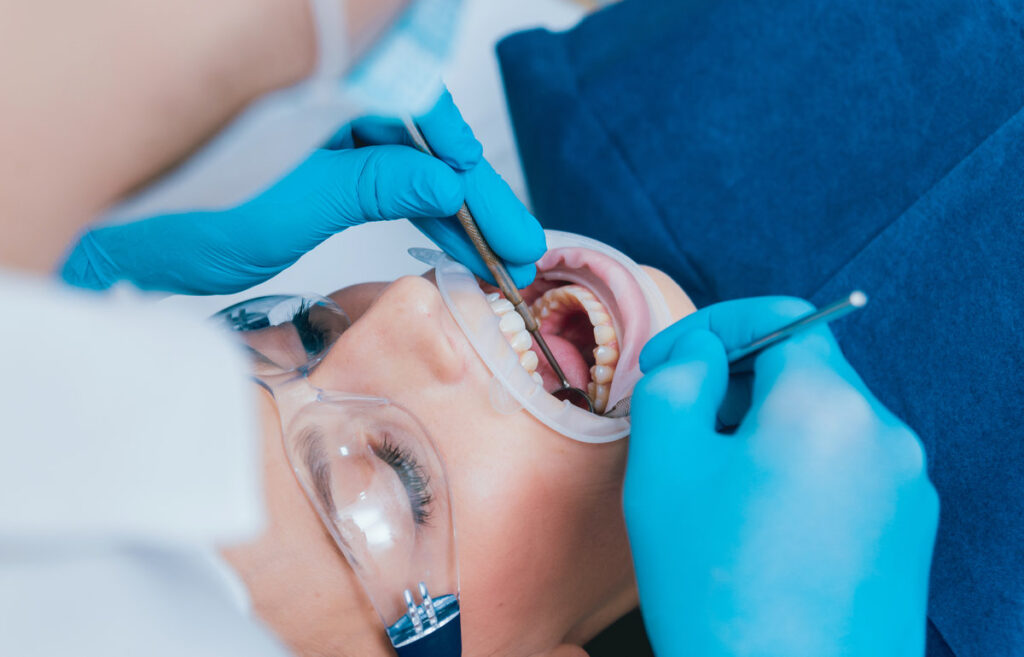
When you arrive, our team begins with a thorough clinical and radiographic evaluation to determine the extent of the displacement and whether any surrounding bone or tissue has been affected. This step is essential before any repositioning takes place.
Once the assessment is complete, the tooth is gently guided back into its correct position under local anesthesia. After repositioning, a flexible splint is placed across the affected tooth and the adjacent teeth to hold everything stable while the periodontal ligament and bone begin to heal. A flexible splint is typically worn for approximately two weeks following an extrusive luxation, though this timeline may be extended if there is any evidence of bone fracture or additional damage around the socket.
Follow-up appointments are scheduled to monitor the tooth’s response and assess pulp health, as there is an elevated risk of pulp complications following this type of injury. In some cases, additional treatment may become necessary during the healing period, and a dental crown may be recommended to restore the tooth’s strength and appearance once healing is confirmed.
Why Prompt Care Protects the Tooth
The longer an extruded tooth remains out of position, the more the surrounding tissue responds to the injury. A blood clot can form in the socket within a few hours, making manual repositioning increasingly difficult or impossible and potentially requiring a more involved procedure to restore the tooth’s position. Early care keeps your options open and gives the periodontal ligament the best chance to re-establish its connection with the bone.
Delaying treatment also increases the risk of infection, pulp necrosis, and long-term root resorption, any of which can shorten the life of the tooth significantly. Our family dentistry team treats this type of injury with the urgency it deserves, and we are committed to helping patients preserve their natural teeth whenever possible.
Emergency Dental Care at North Creek Dental Care
North Creek Dental Care has been a trusted part of the Southland community for decades, and our commitment to patients goes well beyond scheduled cleanings. We accept most major insurance plans, and for after-hours emergencies, our answering service is available nights and weekends to capture your information and get you scheduled at the earliest available time.
If you or your child has experienced a partially dislodged tooth, do not wait. Reach out to our team any time through our contact form and we will get you seen as soon as possible.